

After a recent workshop, a participant lingered to talk. We’d spent our time together exploring two ideas: looking at people and teams through the lens of their strengths, and David Yeager’s mentor mindset, the practice of pairing high standards with high support. Neither idea, she said, was hard to understand, and she had practice similar concepts in the past. She shared the workshop was an important reminder of how she wants to show up in her role – things that are easy to say and hard to do.
I’ve heard some version of that same confession dozens of times. It’s rarely about intelligence or effort. It points to something deeper about how the mind works, and once you see it, you can’t unsee it.
The Simple Idea That Won’t Stay Put
Most leadership concepts worth teaching are, on their face, simple: assume good intent, lead with curiosity before judgment, hold people to high standards while genuinely supporting them, look for what’s strong instead of what’s broken. None of this requires an advanced degree to grasp. A leader can nod along in a workshop, feel the truth of it, and mean every word of their commitment to practice it.
Then Monday happens. Someone misses a deadline, or pushes back in a meeting, or shows up defensive, and the same leader who nodded so easily reverts quickly back to old patterns: judgment first, curiosity later, if at all. The gap isn’t between knowing and caring. It’s between knowing and doing, and it shows up most stubbornly in the moments that matter most: the interpersonal ones.
Why Your Brain Won’t Let You Do Both
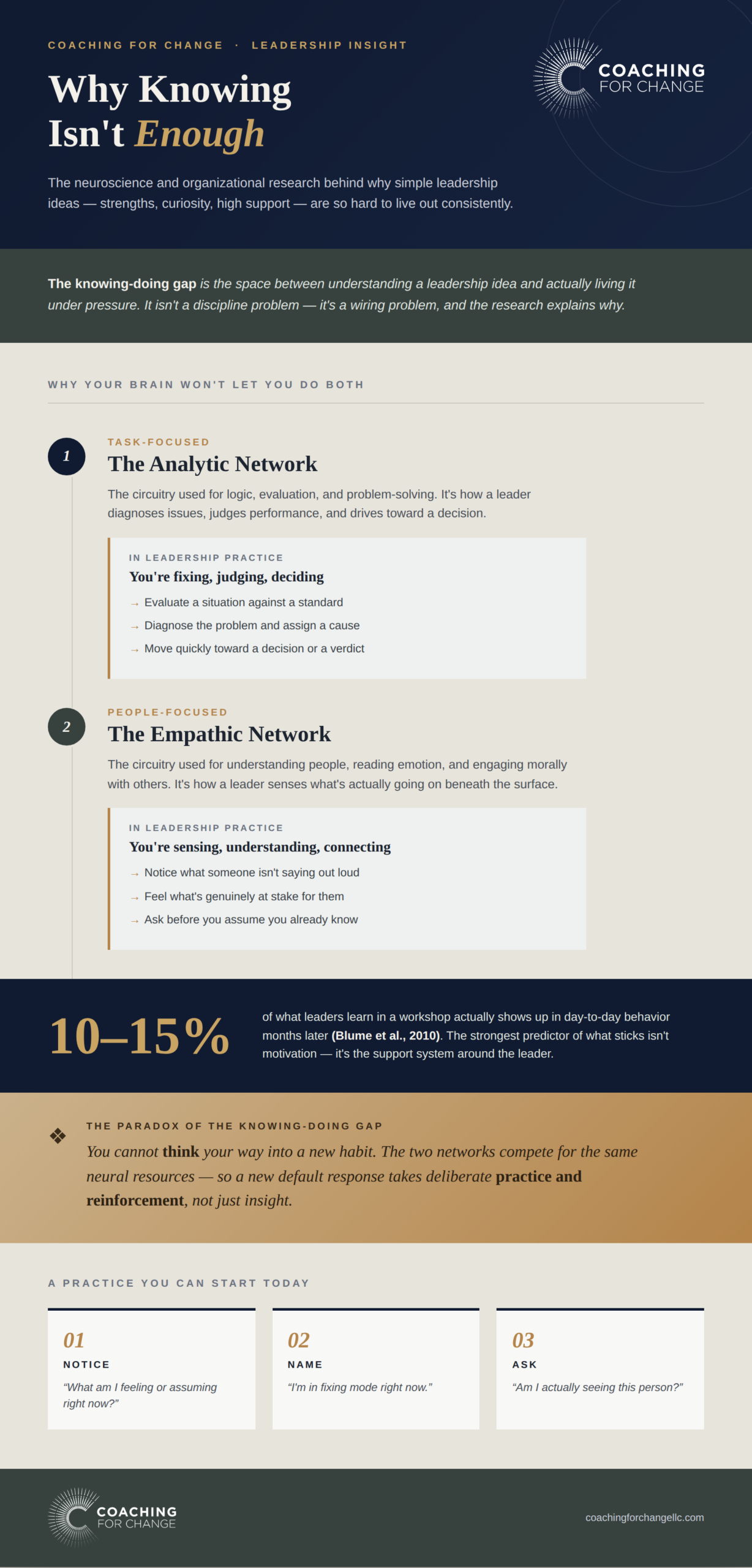
There’s a compelling explanation for this, and it comes from neuroscience. Researcher Anthony Jack and colleagues at Case Western Reserve have found that the brain runs on two large networks that actively suppress one another: an analytic network, used for logic, problem-solving, and evaluation, and an empathic network, used for understanding people, reading emotion, and engaging morally with others. When one fires up, the other quiets down. You genuinely cannot be in full analytic, task-solving mode and full empathic, people-sensing mode at the same time.
Jack and his collaborators, including leadership researcher Richard Boyatzis, have taken this finding directly into leadership and coaching. Their work argues that organizational cultures often over-reward analytic reasoning, the fixing, evaluating, deciding part of a leader’s job, which means the empathic network gets less airtime by default. A leader isn’t choosing to be less curious or less supportive under pressure. Their brain is, quite literally, running a different circuit. Boyatzis’s related research on coaching found something similar: leaders who focus on fixing problems, the real self, actually activate different, competing neural territory than leaders who focus on vision and possibility, the ideal self, and the fixing mode can work against the very growth it’s meant to produce.
This doesn’t mean the mentor mindset or a strengths lens is wrong. It means living them consistently is working against the brain’s own architecture, especially under stress, time pressure, or conflict, exactly the moments a leader most needs them.
It’s Not Just You: The Knowing-Doing Gap
If the neuroscience explains why simple ideas are hard to sustain in the moment, the organizational research explains why they fade over time. Studies on training transfer consistently find that only around 10 to 15 percent of what people learn in a workshop or training actually shows up in their day-to-day behavior months later. Without deliberate reinforcement, new skills decay within about six months, and people quietly drift back to old habits.
What predicts whether new behavior sticks isn’t how good the training was, or even how motivated the individual is. It’s the environment around them: whether there’s ongoing support, whether someone notices and reinforces the new behavior, whether there’s a structure that keeps pulling attention back to it. Jeffrey Pfeffer and Robert Sutton called this the knowing-doing gap at the organizational level, but it plays out identically in an individual leader’s week. Understanding a concept was never the hard part. Building a structure that keeps you accountable to it is.
From Insight to Practice
This is why, in my work with leaders, the goal is rarely to teach a new idea. Most leaders already know, at some level, that curiosity beats judgment and that people rise to high expectations paired with real support. The work is building the intentional practices and the cultivating the empathic reasoning that make the idea automatic rather than aspirational: practicing the pause before reacting, naming what’s happening internally in the moment, and, critically, surrounding yourself with peers and a coach who notice when you slip back into old patterns and help you return.
That last piece matters more than most leaders expect. The research is clear that the strongest predictor of whether new behavior sticks is the support system around it, not willpower. This is exactly why cohort-based coaching, where leaders practice alongside peers who hold them accountable between sessions, tends to outperform one-off training. Insight fades. Community and structure don’t.
A Practice You Can Start Today
The next time you feel that flash of judgment or defensiveness rising in a conversation, try pausing for one breath before responding. Ask yourself: Am I in fixing mode right now, or am I truly seeing this person? That single question, repeated often enough, is how the empathic network gets stronger relative to the analytic one. It won’t happen from reading this post. It happens from practicing it, in real conversations, with real support around you.
Want help building the structure that turns simple ideas into lasting leadership habits? Reach out to explore how coaching and cohort-based collectives can help your leaders build the skills to close their own knowing-doing gap.