There’s a moment most leaders know well. A colleague pushes back in a meeting, and before you’ve even fully heard them, you feel it: a flash of defensiveness, a tightening of your position. In that moment, you’re not leading. You’re reacting.
What separates the leaders who navigate that moment gracefully from those who don’t isn’t experience or title. It’s a cognitive skill that psychologists call decentering, and it may be the most underrated capability in a leader’s toolkit.
What Is Decentering?
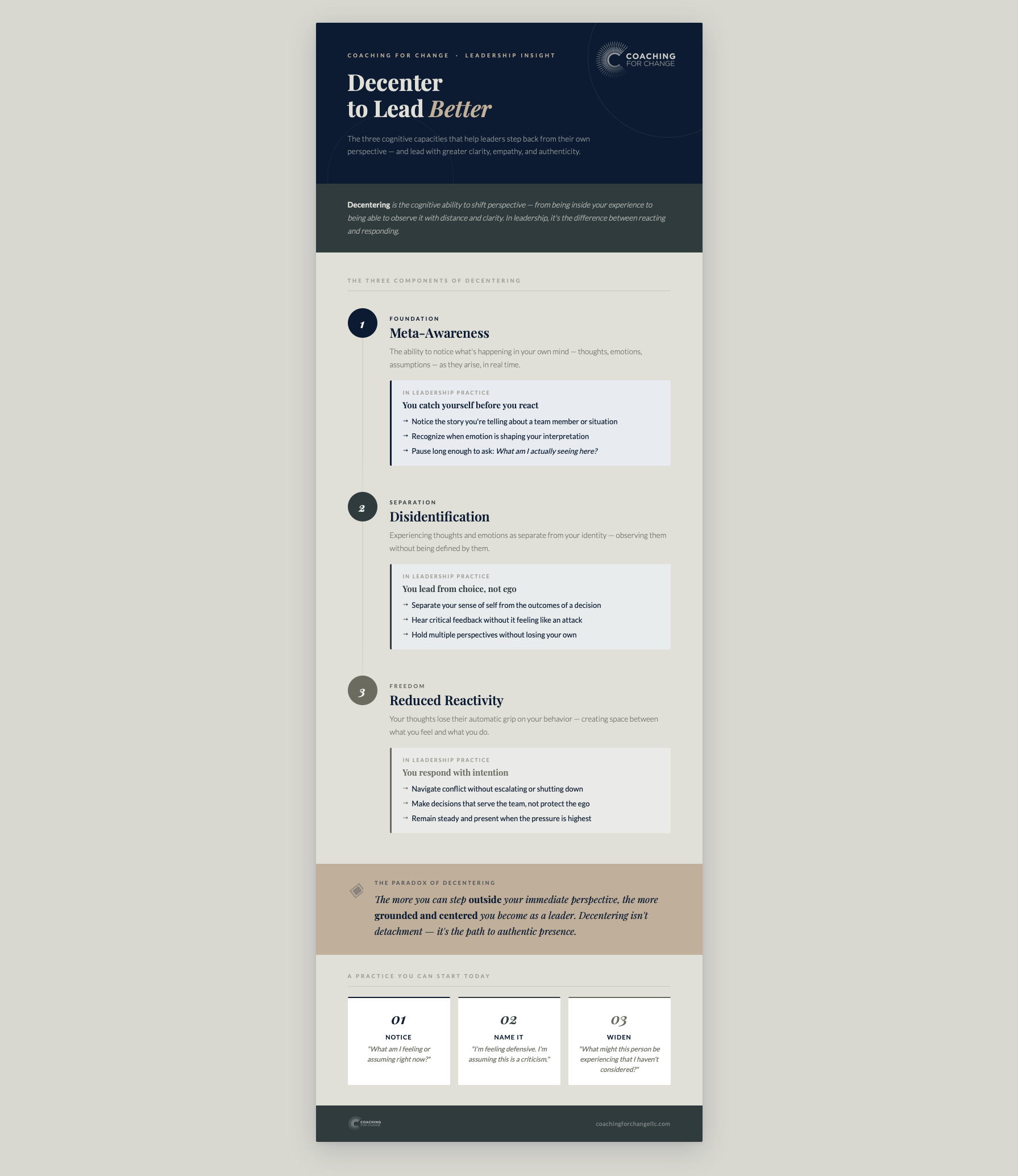
Decentering is the ability to step outside of your immediate experience and observe it from a broader vantage point. Researchers describe it as the capacity to shift perspective: from being inside your subjective experience to being able to look at that experience with some distance and clarity.
In psychological science, decentering involves three interrelated processes: first, developing meta-awareness, or the ability to notice what’s happening in your own mind in real time; second, de-identification from internal experience, the ability to observe your thoughts and emotions without being completely fused with them; and third, reduced reactivity to thought content, where the thoughts you’re having lose their automatic grip on your behavior. Together, these processes don’t eliminate your perspective; they free you from being trapped inside it.
In clinical settings, decentering has been shown to reduce anxiety, break cycles of rumination, and increase psychological flexibility. But its implications for leadership are just as profound, and far less explored.
Why This Matters for Leaders
Leadership inherently requires holding multiple realities at once. In any given day, you’re expected to see the world through the eyes of a direct report who’s struggling, a senior leader who’s under pressure, a customer who’s frustrated, and an organization navigating change. The leader who can only see things through their own lens — filtered through their assumptions, ego, and emotional reactions — will consistently miss the fuller picture.
This is exactly what decentering makes possible.
When you decenter, you don’t abandon your perspective. You expand it. You become capable of asking: What is the person before me experiencing right now? What am I assuming that might not be true? Is my reaction to this situation telling me something important, or is it getting in my way?
That shift, from being in your experience to being able to witness it, is what allows leaders to respond rather than react. It’s what makes it possible to give honest feedback with genuine care, to hold a difficult conversation without it becoming personal, and to make decisions that serve the team rather than protect the self.
Decentering as a Leadership Practice
In my coaching work, decentering is one of the most central and transformative processes I see leaders develop. And it’s rarely what they expect.
Leaders often come in expecting to work on strategy, communication, or managing up. What they discover is that many of the challenges they face (the team member they can’t seem to connect with, the conflict that keeps resurfacing, the meetings where they leave feeling unheard) are actually invitations to look inward. Not in a self-critical way, but in a curious, observant way.
The work begins with building meta-awareness: learning to notice, in real time, what’s happening inside of you. What are you feeling? What story are you telling yourself about this situation? What assumptions are quietly running the show?
From there, we practice de-identification: recognizing that just because you think something doesn’t mean it’s an accurate read on reality. The thought “they don’t respect me” is just a thought, not a fact. The feeling of frustration is data, but it’s not a mandate. This is the difference between being swept away by your inner experience and being able to work with it.
Finally, we explore what opens up when your reactions lose their automatic grip, when there’s space between stimulus and response. That space is where authentic leadership lives.
Decentering to Become More Centered
Here’s the paradox at the heart of this practice: the more you can step outside your immediate perspective, the more grounded and centered you become as a leader.
When you’re fused with your assumptions, your ego, and your emotional reactions, your leadership is fundamentally reactive. You’re responding to the noise. But when you can decenter — when you can pause, observe, and choose your response — you lead from a place of intention rather than impulse. You become more present to the people in front of you, more curious and less defensive, more able to hold complexity without collapsing it into a simple narrative.
This is what I mean when I say that the most effective leadership work happens from the inside out. You cannot build a culture of trust, feedback, or psychological safety if you can’t first create that space within yourself. Decentering is how you do that.
A Practice You Can Start Today
You don’t need a formal coaching engagement to begin practicing decentering. The next time you’re in a difficult conversation or feeling reactive, try this:
Notice what’s happening in your body and mind: not to judge it, but simply to observe it. Name it: I’m feeling defensive right now. I’m assuming this is a criticism. Then ask yourself: What am I not seeing? What might this person be experiencing that I haven’t fully considered?
That moment of noticing, that brief pause between what you feel and what you do, is decentering in practice. And with time, it becomes one of the most powerful habits a leader can build.
The best leaders I’ve worked with don’t have all the answers. But they have learned to get out of their own way to search for them.
Interested in developing this capacity in yourself or your leadership team? Reach out to explore how coaching and cohort-based learning can help your leaders build the skills to lead from the inside out.