

A leader I work with recently said something I’ve heard in different forms more times than I can count.
Her organization was in the middle of a significant transition. The team felt fragmented. People weren’t sure how they related to each other anymore: who was responsible for what, who to turn to for what, what was okay to say and what wasn’t. For this CEO it was expected: “Change is messy. That’s just the nature of it.”
Yes, change is messy. And you can fumble your way through that mess, or you can use what we know about human behavior to set your organization up for success. Those two things aren’t in conflict. The mess doesn’t go away, but whether you work to “clean it up” matters enormously.
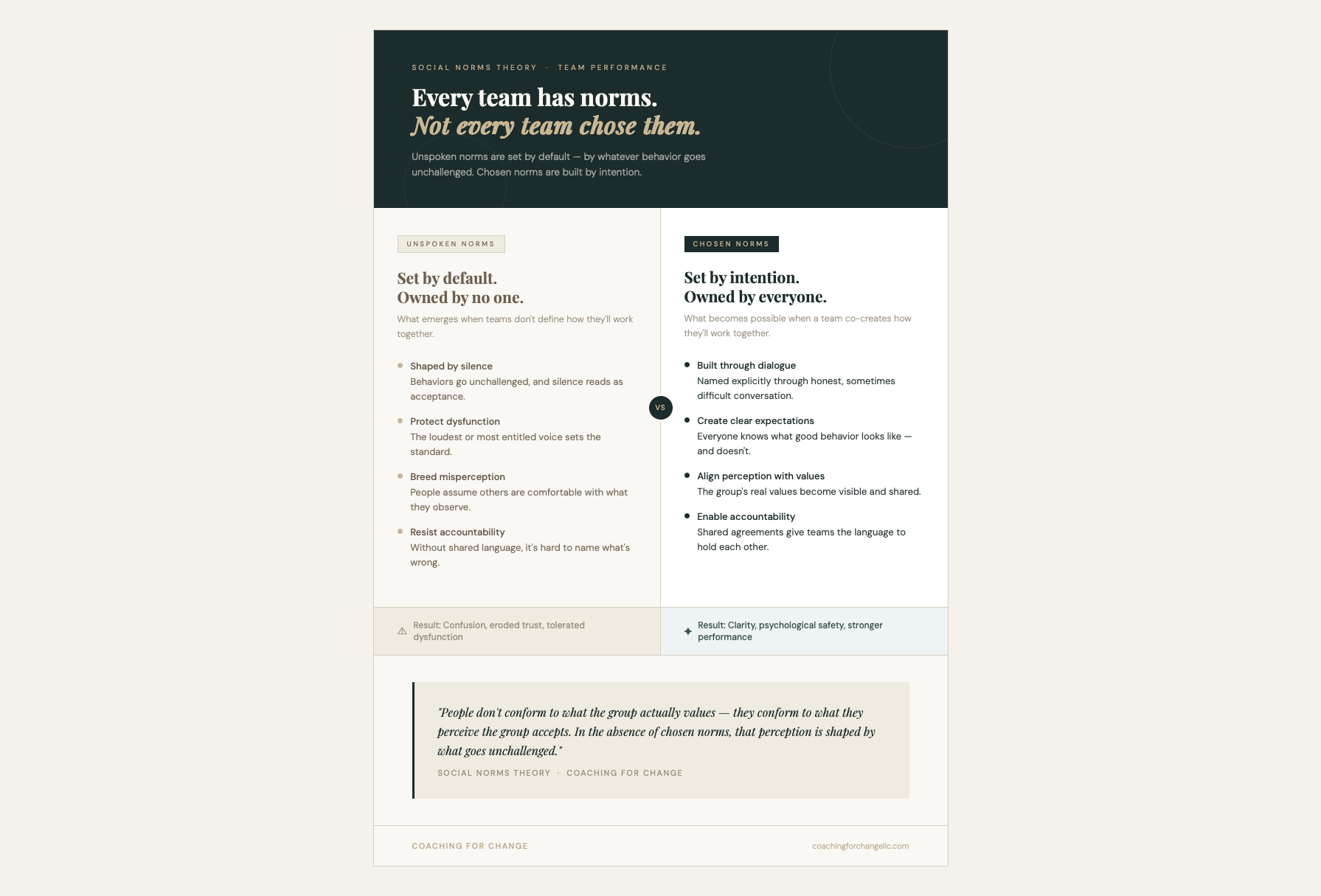
The science backs this up. Social norms theory tells us that human behavior is powerfully shaped by what we perceive as acceptable within our group. When people are uncertain (as they almost always are during change) they look to those around them for cues about how to act. We are wired for conformity, not out of weakness, but because reading the group is how humans have always navigated ambiguous situations. The problem is that we don’t conform to what the group actually values — we conform to what we perceive the group accepts. And in the absence of explicit norms, that perception is shaped entirely by the behavior we see.
This is where team norms come in. Not as a bureaucratic exercise. Not as a feel-good team-building moment. But as a way of making values explicit. A way of intentionally shaping how to work together.
You Already Have Norms. You Just Didn’t Choose Them.
Here’s what most leaders miss: every team already operates by norms. They’re just unspoken.
And unspoken norms are set by default — by whatever behavior goes unchallenged. The colleague who dominates every meeting without pushback becomes a norm. The “meeting after the meeting” becomes a norm. The leader who can’t accept feedback becomes a norm.
The Messy Work of Building Better Norms
The process of developing explicit team norms is not always clean or comfortable.
With this team in transition, it involved real tension. Difficult conversations. In some ways, the process of building the norms was a microcosm of exactly what the norms were meant to address: navigating conflict, speaking directly, assuming positive intent even when it was hard. That messiness wasn’t a sign something was going wrong. It was a sign the implicit was being made explicit.
What came out the other side was a shared set of commitments the team genuinely wrestled with and owned. And that ownership is everything. Behavior change science is clear on this point: people support what they help create. Norms handed down from above get compliance at best. Norms co-created by the people who have to live by them get something closer to belief.
Social norms research tells us that people are wired to follow what they perceive the group accepts. The operative word is perceive. We often misread our own group’s actual values, assuming others are more comfortable with dysfunction than they really are, because no one says otherwise. Silence reads as acceptance.
What Shifted
Once the norms were in place, something interesting happened. Behaviors that had been tolerated — because there was no shared language to name them as unacceptable — were now clearly outside the lines. People had a reference point. And more importantly, they had a shared commitment to hold each other to it.
The team began to expect something different of each other: to approach interactions from a place of positive intent. To raise concerns directly rather than around the edges. To treat mistakes as information rather than as deficits.
The culture didn’t transform overnight. But it shifted. And it shifted because the team had built the infrastructure for something better, not by waiting for the mess to resolve itself, but by doing intentional work inside it.
The Question Worth Sitting With
If your team is in the middle of change right now, or even if things feel relatively stable, I’d invite you to ask: What are the unspoken norms on my team? And did we choose them?
Because if you didn’t choose them, something else did.
For more on how to set team norms, check out Future Forum’s What are team level agreements?
Coaching for Change partners with leaders and organizations to navigate change with intention. If this resonated, reach out to start a conversation.